Los peces nacen en el agua, el hombre nace en el Tao.Si los peces, nacidos en el agua, buscan la sombra profunda del estanque o la alberca, todas sus necesidades son satisfechas.Si el hombre, nacido en el Tao, se hunde en la profunda sombra de la no-acción, para olvidar la agresión y las preocupaciones, no le falta nada, su vida es segura.
Moraleja: "Todo lo que necesita el pez es perderse en el agua.Todo lo que necesita el hombre es perderse en el Tao".

AVISO

queridos amigos los haikus que humildemente escribo están en este sitio: www.haikusilvestre.wordpress.com
gracias ! Namasté
Mostrando entradas con la etiqueta arte tibetano. Mostrar todas las entradas

8 ago 2016

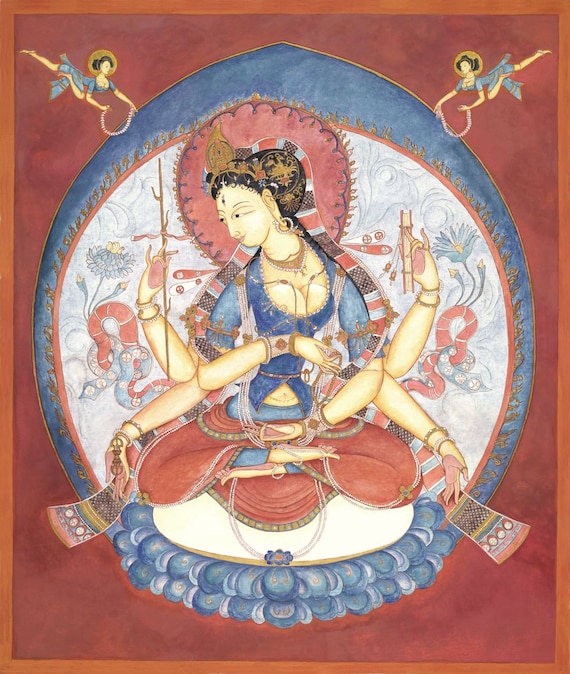
PRAJNAPARAMITA

Prajnaparamita, Mother Goddess of the Past, Present, and Future, Dharma, Meditation, Wall art, buddhism, incense, spiritual art, Himalayan


The Ancient Goddess of Wisdom


The concept of the goddess Prajnaparamita originally began as a reverence for sacred writings about paths to wisdom, handed down and preserved, in a time when books and writings and education were scarce and hard to come by. Over time these sutra writings, called the “Perfection of wisdom”, or “Prajnaparamita”, were distilled into two great works, the Diamond Sutras and the Heart Sutras. These texts were the subject of worship in Mahayana Buddhism, in much the same way that devotional figures were. Under the influence of Tantric Buddhism they became deified as the Goddess of Wisdom. Prajnaparamita is also called the mother of all three times - the past, present, and future. She is radiantly beautiful and sweet.


© Laura Santi

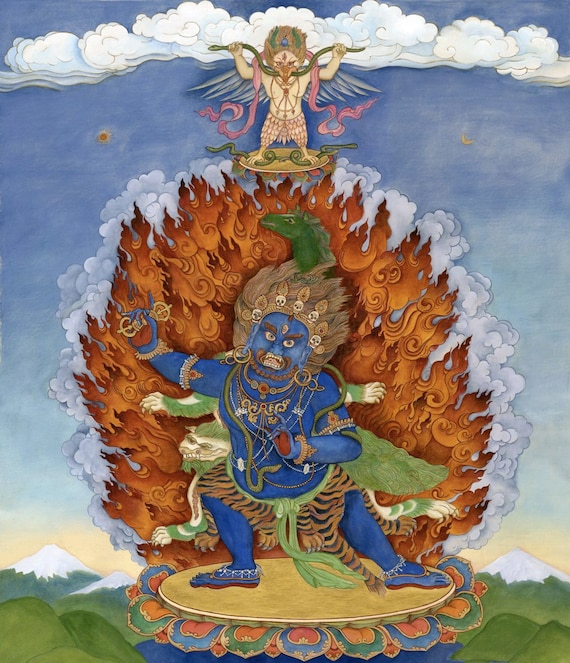
VAJRAPANI & HAYAGRIVA

Vajrapani & Hayagriva, with Garuda above Yidam Deity Buddhist Deity Bodhisattva meditation Dharma protector Temple guardian thangka thanka


Guardian of the Faith


Protector of the teachings and remover of obstacles to the teaching, strong and unwavering, massive and grounded – no one can get past Vajrapani. He stands here in warrior pose, clasping a vajra, symbol of the energy channels of the body, with his other hand raised in the threatening gesture. He represents the power of all the Buddhas of past, present and future. A statue of Vajrapani is placed at the entrance to monasteries and temples to ward of those that would harm the teachings or the sangha, or temple. Vajrapani is sometimes situated next to the Buddha with Avalokitesvara on the opposite side. Here he is the central figure.

Hayagriva is a yidam, or personal protector deity, the fierce form of Avalokitesvara and represents fierce compassion. The Bird-man above, Garuda, is the eagle of wisdom; he too is here acting as guardian and protector, enemy of the snake race, the nagas lords and ladies of the underworld.

© Laura Santi

23 sept 2014

tangkhas

Chakrasamvara and Vajravarahi..Thiis depiction of the twelve-armed Chakrasamvara embracing his consort Vajravarahi depicts  charged vision tantric master. The blue figure Chakrasamvara has additional heads in yellow, green, and red . .This Nepalese paintings to evok Chakrasamvara is associated with both Heruka and Hevajra,. Such concordance of Buddhist and Hindu iconography ihas its origins in tantrism of medieval eastern India

Chakrasamvara and Vajravarahi..Thiis depiction of the twelve-armed Chakrasamvara embracing his consort Vajravarahi depicts charged vision tantric master. The blue figure Chakrasamvara has additional heads in yellow, green, and red . .This Nepalese paintings to evok Chakrasamvara is associated with both Heruka and Hevajra,. Such concordance of Buddhist and Hindu iconography ihas its origins in tantrism of medieval eastern India
Medicine Buddha, by Kalsang Dawa
medicine Buddha


Ben Christian, Vajradhara Buddha
contemporary tangkha
Vajradahara Buddha


Chenrezig thangka, Avalokiteshvara, Bodhisattva of Compassion, crowned by Amitabha, Tibetan Buddhism
Yamantaka, Tibetan Buddhism.
Yamantaka

Tangka
Tara is a female Buddha and one of the most prominent female deities in Nepalese and Tibetan Buddhism. The name Tara means the “one who saves” and as the goddess of compassion, her job is to alleviate people from suffering.


Such a beautiful Thangka!

Tangka
buddha