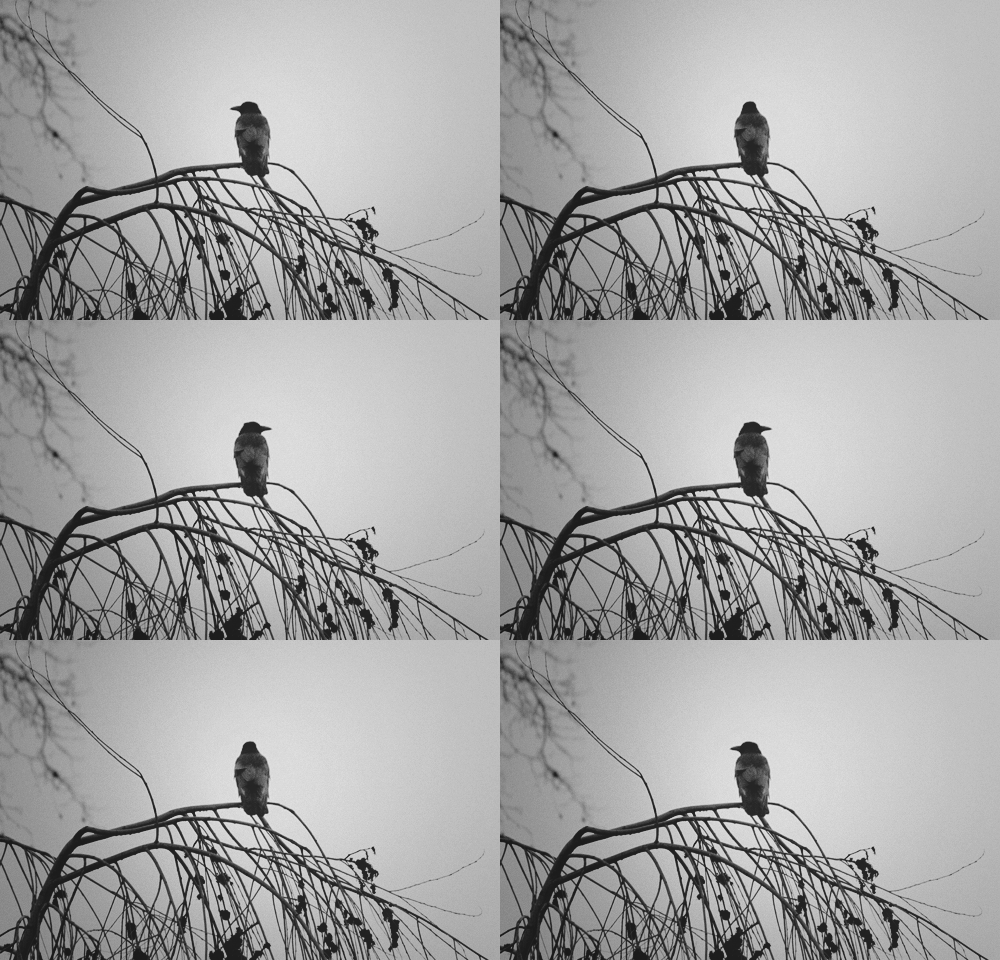
Los peces nacen en el agua, el hombre nace en el Tao.Si los peces, nacidos en el agua, buscan la sombra profunda del estanque o la alberca, todas sus necesidades son satisfechas.Si el hombre, nacido en el Tao, se hunde en la profunda sombra de la no-acción, para olvidar la agresión y las preocupaciones, no le falta nada, su vida es segura.
Moraleja: "Todo lo que necesita el pez es perderse en el agua.Todo lo que necesita el hombre es perderse en el Tao".

AVISO

queridos amigos los haikus que humildemente escribo están en este sitio: www.haikusilvestre.wordpress.com
gracias ! Namasté
Mostrando entradas con la etiqueta dao. Mostrar todas las entradas

28 jun 2016


Empty and desireless,
Cold and thin, simple and genuine,
This is how to strike down
And fold up the remaining habits
Of many lives.
When the stains from old habits
Are exhausted,
The original light appears,
Blazing through your skull,
Not admitting other matters.
Vast and spacious,
Like sky and water merging
During autumn,
Like snow and moon
Having the same color,
This field is without boundary,
Beyond direction,
Magnificently one entity
Without edge or seam.
— Hongzhi

***

Vacía y sin deseo,
Fría y delgada, simple y genuina,
Esta es la manera de doblegar
Y plegar los hábitos restantes
De muchas vidas.
Cuando las manchas de los viejos hábitos
Se han agotado,
Aparece la luz original,
Abriéndose paso por tu cráneo,
No Admitiendo otros asuntos.
Vasta y amplia,
Al igual que el cielo y la fusión del agua
Durante el otoño,
Como la nieve y la luna
Teniendo el mismo color,
Este campo es sin límite,
Más allá de dirección,
Magníficamente una entidad
Sin borde o costura.
- Hongzhi

11 abr 2016

with full text (link)

Chan masters often advise their disciples that the Buddhist reality "is not something that can be obtained through descriptive words and language." "Those who search for written words, and thereby look for the corresponding reality, become even more impeded by them." A similar, but more forceful, critique appears in the Linji lu. Linji repeatedly points out that Buddha, dharma, dao -- "all are empty names and designate no true reality." All Buddhist doctrines and teachings are "simply medicines to cure diseases of the moment"; "None of them designate any true reality." He further declares:

The various phenomena in this world and other worlds are in all cases devoid of self-nature.... They are empty names, and the words used to describe them are likewise empty. But you think these idle names represent realities. This is a great error.

***

Los maestros Chan suelen aconsejar a sus discípulos que la realidad budista "no es algo que se puede obtener a través de palabras y lenguaje descriptivo." "Los que buscan palabras escritas, y por lo tanto buscan la realidad correspondiente, se vuelven aún más obstaculizados por ellas." Una similar, pero más contundente crítica aparece en Linji lu. Linji señala reiteradamente que Buda, el dharma, DAO - "todos son nombres vacíos y designan ninguna realidad verdadera". Todas las doctrinas y las enseñanzas budistas son "simplemente medicinas para curar las enfermedades del momento"; "Ninguno de ellos designa ninguna realidad verdadera". Él declara además:

     Los diversos fenómenos en este mundo y otros mundos son en todos los casos carentes de la propia naturaleza .... Son nombres vacíos, y las palabras que se usan para describirlos son igualmente vacías. Pero usted piensa que estos nombres ociosos representan realidades . Este es un gran error.


with full text (here)

25 nov 2015

wu wei

In Taoism, the concept of Wu Wei (effortless effort) is the idea of moving with the least amount of stress or effort when performing an action. By doing this, our bodies allow nature to take its course and we let our egos and conscious efforts yield to a power not to their own.

***

En el taoísmo, el concepto de Wu Wei (esfuerzo sin esfuerzo) es la idea de moverse con la menor cantidad de estrés o esfuerzo al realizar una acción. De esta manera, nuestros cuerpos permiten que la naturaleza siga su curso y permiten a nuestros egos y esfuerzos conscientes ceder a un poder y no al suyo.

12 oct 2015

anónimo taoista -- Anonymous Taoist (late Qing dynasty (1644-1911)


In ancient times someone asked a master about his sleep:
“In a single sleep you take in the primordial wholeness of the universe; when you wake up you break through the going and coming of past and present. Marvelous! Is there also a Way of sleep?”

He said, “There is a Way. When ordinary people sleep, they first let their eyes go to sleep, then their minds. When I sleep, I first let my mind go to sleep, then my eyes. When I wake up, first I wake my eyes, then my mind. By wakefulness of eye, I see mind; when mind awakens, I do not see the world. When I do not see the world, neither do I see mind. I sleep mindlessly and awaken without minding.”

The questioner asked, “If I want to learn to be unmind­ing, how can I do so?”

The master replied, “Don’t notice mind when dealing with objects, and don’t notice objects when dealing with mind. This is all I know-how could I know anything else? When you wake up, there’s nothing to know; the more you know, the more tired the mind.”

Anonymous Taoist (late Qing dynasty (1644-1911), Secret Records of Understanding the Way,
Thomas Cleary translated and edited, Taoist Meditation: Methods for Cultivating a Healthy Mind and Body.

***

En la antigüedad, alguien le preguntó a un maestro de su sueño:

"En un solo sueño que tomas en la totalidad primordial del universo; cuando te despiertas rompes el ir y venir del pasado y el presente. Maravilloso! ¿Hay entonces un camino del sueño? "

Él dijo: "Hay un Camino. Cuando la gente común duerme, primero dejan que sus ojos duerman, luego sus mentes. Cuando duermo, primero dejo que mi mente duerma, luego mis ojos. Cuando me despierto, primero despierto mis ojos, luego mi mente. Por la vigilia del ojo, veo a la mente; cuando la mente despierta, no veo el mundo. Cuando no veo al mundo, ni asi veo la mente. Duermo sin pensar y despierto sin pensamiento".

El preguntante pregunta, "Si quiero aprender a ser sin-mente, ¿cómo puedo hacer eso?"

El maestro le respondió: "No notes a la mente cuando trabajas con objetos, y no notes los objetos cuando trabajas con la mente. Esto es todo lo que sé, ¿cómo podría saber algo más? Cuando te despiertas, no hay nada que saber; cuanto más sabes, más se cansa la mente. "
-
Dinastía Anónimo taoísta (finales de Qing (1644-1911), Secret Records de Entendimiento el Camino,
Thomas Cleary traducido y editado, taoísta Meditación: Los métodos para cultivar una mente sana y cuerpo.

Julien Douvie photography


8 ago 2015


Quotation out of the book:

Unfathomable Tao

One looks for it and sees it not,
it is called: invisible.
One listens for it and hears it not,
it is called: inaudible.
One reaches for it and grasps it not,
it is called: intangible.

These three, not examinable through reasoning,
interwoven with one another they are one.

Its upper is not light,
its lower is not dark.
Ceaselessly onwards it flows,
endless, nameless,
and returns to the being-less.

That is: of the formless form,
of the imageless image.
That is: the most unfathomable of the unfathomable.

One approaches it and sees not its beginning.
One follows it and sees not its end.

When the Tao of the forefathers is preserved,
to guide the essence of today,
from time immortal one can Know.
This is called: endless unfolding of the Tao.

source: facebook

The light of the sun rises over the earth is by nature clear. The higher the s u n rises, the more it emerges from the dark mists, spreading the pristine purity of its rays over an ever widening area. The real nature of man is likewise originally good, but it becomes clouded by contact with earthly things and therefore needs purification before it can shine forth in its native clarity - Wilhelm/Baynes I-Ching

La luz del sol que se eleva sobre la tierra es, por naturaleza, clara. Cuanto mas alto el sol se levante, más surge de las brumas oscuras la difusión de la prístina pureza de sus rayos sobre un área cada vez más amplia. La verdadera naturaleza del hombre es también originalmente buena, pero se nubla por el contacto con las cosas terrenales y por lo tanto necesita de purificación antes de que pueda brillar en su claridad nativa

- Wilhelm / Baynes I-Ching

6 jun 2015


Empty yourself of everything.
Let the mind become still.
The ten thousand things rise and fall while the Self watches their return.

They grow and flourish and then return to the Source.
Returning to the Source is stillness, which is the way of Nature.

Lao Tsu
Tao Te Ching, Verse 16